
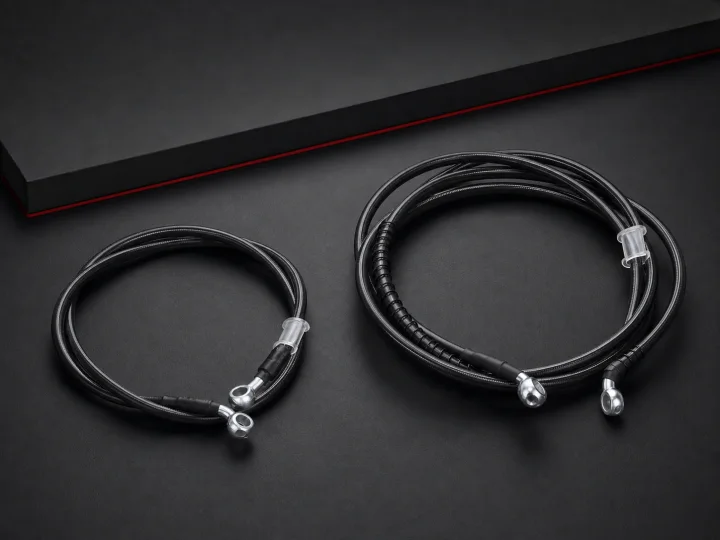
A hydraulic brake hose assembly must be selected as part of a defined brake system. Visual similarity, nominal fitting labels or hose length alone cannot confirm compatibility. The buyer should identify the vehicle, lever, caliper, fluid, both end connections, routing, required validation and target market before quotation or sample approval.
This guide supports initial ChiZe brake line inquiries. It does not publish universal compatibility, working-pressure, burst-pressure, temperature or compliance claims. Those values require evidence for the exact configured product.
Minimum Hydraulic Brake Hose RFQ Inputs
Provide these fields for an initial review:
- Vehicle type, model and target market.
- Front or rear installation position.
- Brake lever and caliper manufacturer and model.
- Required hydraulic fluid.
- Hose inner and outer diameter when controlled by the buyer.
- Lever-end fitting, thread, insert, olive and seal requirements.
- Caliper-end fitting, banjo or straight connection and orientation.
- Finished assembly length and measurement method.
- Routing, steering, suspension and bend constraints.
- Protective sleeve, coil guard or abrasion protection.
- Required working, proof and burst pressure evidence.
- Temperature, fatigue, pull-off, expansion and leakage criteria.
- Quantity, sample stage and required approval documents.
Mark unknown fields as open review items. Do not fill them with values taken from another brand’s hose.
1. Identify the Complete Brake System
| Input | Buyer information to provide |
|---|---|
| Vehicle | E-bike, cargo bike, scooter, moped or another platform |
| Brake position | Front or rear |
| Lever | Manufacturer, model, connection and available drawing |
| Caliper | Manufacturer, model, connection and available drawing |
| Fluid | Exact mineral oil or DOT specification required by the brake system |
| Existing assembly | Original part number, photos, measured sample and service information |
Official compatibility matrices demonstrate that hose selection depends on the lever, caliper and connection combination. For example, Shimano lists lever, caliper, hose model and straight or banjo connection together in its hydraulic brake hose compatibility matrix. That matrix applies to Shimano products and must not be represented as ChiZe compatibility evidence.
2. Keep Fluid Compatibility Explicit
The RFQ must identify the fluid required by the complete brake system. “Hydraulic oil” is not a sufficient specification.
- State the exact fluid family and system requirement.
- Confirm the hose inner tube, reinforcement, outer cover, seals and fittings against that fluid.
- Prevent cross-contamination during sampling, assembly and testing.
- Identify any buyer-specified cleaning, labeling or traceability requirement.
- Do not convert a brake system from one fluid type to another without authorization from the system owner.
SRAM’s official hose selection guide warns that brake systems are designed for a specific fluid and describes risks from mixing mineral and DOT fluids. See SRAM hydraulic brake hose kit selection. That guidance concerns SRAM systems and is cited only to demonstrate the importance of fluid-specific selection.
3. Define Both End Interfaces
An end designation such as “M10” does not define a complete sealing interface. Record each connection separately.
| Interface field | What to confirm |
|---|---|
| Connection style | Straight, banjo, crimped, compression, threaded or another drawing-defined form |
| Thread | Diameter, pitch, thread standard and engagement length |
| Sealing method | Olive, insert, washer, O-ring, cone or another controlled surface |
| Fitting angle | Fixed or adjustable angle and clocking orientation |
| Hardware | Nut, bolt, washer, boot, insert, olive and protective components included |
| Installation | Assembly sequence, tool, torque and service instruction owner |
Use mating-part drawings, approved samples or controlled original-part references. A photo can support identification but cannot establish hidden threads or sealing geometry.
4. Specify Length and Routing
Define how length is measured. Possible reference points include fitting centers, sealing faces or hose-only cut length; these values are not interchangeable.
The routing brief should include:
- Front or rear installation.
- Fixed reference points for finished length.
- Steering movement and handlebar rotation.
- Suspension travel where applicable.
- Internal or external routing.
- Frame-entry and exit geometry.
- Minimum bend requirement from the applicable design source.
- Abrasion, heat and moving-part exposure.
- Fitting orientation at both ends.
- Length and angular tolerances.
Validate the routed assembly on a representative vehicle or controlled fixture before production approval.
5. Define Hose Construction Without Guessing
Where the buyer controls the construction, state:
- Inner tube material and fluid basis.
- Inner and outer diameter.
- Reinforcement material and layer structure.
- Outer cover material and finish.
- Braided outer protection, sleeve or coil guard.
- Color and identification marking.
- Minimum bend requirement.
- End-fitting attachment method.
If a supplied source only shows external appearance and length, the website or quotation should not infer pressure rating, internal construction or temperature range.
6. Request Product-Specific Evidence
| Evidence | Required identification |
|---|---|
| Dimensional report | Drawing revision, length method, fittings and sampled quantity |
| Leakage or proof test | Configured assembly, fluid, pressure, duration and acceptance criteria |
| Burst test | Assembly condition, fluid or medium, conditioning, method and result |
| Pull-off test | Hose, fitting, crimp configuration, method and acceptance value |
| Fatigue test | Pressure cycle, temperature, routing, cycle count and failure criteria |
| Temperature evaluation | Fluid, conditioning, temperature range and post-test inspection |
| Material or compliance report | Exact material, report owner, date, scope and target-market relevance |
A report for a loose hose does not automatically validate a completed hose-and-fitting assembly. The evidence scope must match the claim being made.
7. Establish Approval and Change Control
Before production release, approve:
- Vehicle and brake-system reference.
- Fluid type.
- Hose and fitting drawing.
- Finished length and fitting orientation.
- Sealing parts and supplied hardware.
- Routing and fit sample.
- Test and inspection requirements.
- Identification and packaging.
- Approved sample or controlled specification revision.
Any change to hose material, reinforcement, fitting, crimp, seal or assembly process should trigger review against the agreed change-control requirements.
Frequently Asked Questions
What information is required for a hydraulic brake hose RFQ?
Provide the vehicle and brake system, fluid type, lever and caliper references, both end interfaces, hose length and routing, fitting orientation, required validation, quantity and target market.
Can mineral oil and DOT hoses be treated as interchangeable?
No. The hose, seals and complete brake system must be approved for the specified fluid. Do not change or mix fluid types without system-manufacturer authorization.
Is an M10 designation enough to confirm fit?
No. A designation alone does not establish thread form, pitch, sealing surface, fitting angle, insert, banjo, washer, torque or mating-component compatibility.
How should brake hose length be specified?
Define the measurement method and reference points, installation position, routing path, steering and suspension movement, bend limits, fitting orientation and allowable tolerance.
What evidence should support a pressure or temperature claim?
Use a report or controlled test record that identifies the exact configured hose, fittings, fluid, conditioning, method, acceptance criteria, date and responsible test source.